
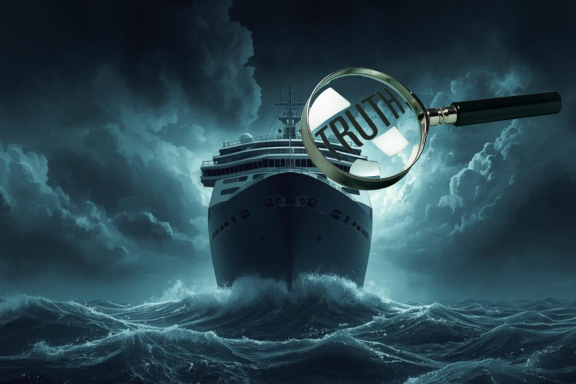
The Dark Side of the Cruise Industry: What Passengers Are Never Told
Key Takeaways
- Amsterdam aims to reduce cruise ship arrivals from 190 to 100 per year by 2026 due to pollution and cultural impact.
- The cruise industry faces criticism for its labor exploitation and environmental damage, affecting millions of passengers yearly.
- Flag of Convenience allows cruise lines to minimize labor costs and evade strict regulations by registering ships under foreign flags.
- Cruise ships significantly pollute oceans, with one ship producing vast amounts of sewage and emissions, often exceeding land-based pollutants.
- Despite claims of economic benefits, local economies see minimal returns from cruise tourism as most visitors spend little onshore.
The Dark Side
Imagine sitting in a peaceful café by large French windows in Amsterdam looking out into the city. It’s a busy day yet tranquil. A few moments later, the crowds walking by start to grow from hundreds to thousands. They are loud and talking amongst themselves and none of them come into the café. They line up at McDonald’s and pack into the chain restaurant across the way. Suddenly, as fast as they appeared, they are gone. They all came from and returned to the massive cruise ship docked at Amsterdam’s cruise port.
Eliminating Ships
Amsterdam is one of many cities with a goal of eliminating the ships from arriving at their ports. They are starting with cutting the limit of 190 ships a year that may dock down to 100 by 2026, according to USA Today. Amsterdam Deputy Mayor Alderman Hester van Buren is quoted in the same article saying “sea cruising is a polluting form of tourism and contributes to crowds and emissions in the city.” Mayor Femke Halsema feels that cruise visitors spend just a few hours at chain restaurants instead of immersing themselves in the culture, and do nothing to meaningfully contribute to the city.
Amsterdam’s rebellion against the cruise industry represents a growing pushback from across the globe. Tens of millions cruise each year, yet the entire industry is effectively controlled by just three companies, a concentration of power that critics argue makes accountability nearly impossible. The industry has drawn criticism for its massive environmental impact, its exploitation of laborers from developing nations, and its minimal tax contributions. From the outside, it appears to be a luxury vacation with the promise of an easy way to see the world on a budget. The true cost of cruising, however, is much higher than advertised.
All Aboard
In 2025, the world’s cruise ships welcomed well over 33 million passengers aboard their vessels. That’s 33 million people taking part in a very complex, controversial, and for some, essential business that is the cruise industry. To most travelers, cruising offers an incredibly convenient way to vacation: lock in one itinerary, show up at the port on time, and let the rest just happen. The ship and its crew take care of you while you meet new friends and see new places. However, there is a lot that most passengers don’t know.
Those aboard relaxing on their superficial vacation are often blissfully unaware that the cook who just prepared their meal and the housekeeper who tidied their cabin are making pennies on the dollar. The port they just visited wasn’t a genuine representation of the country whose soil it sits on, yet so many locals rely on that business to survive. While travelers gaze out at the peaceful ocean from their balcony, they remain unaware of the irreversible damage the ship is doing to the environment. Below, I’ll take a look at each of these concerns and offer an eye-opening look at a side of the cruise industry you may never have considered.
Flag of Convenience and Labor
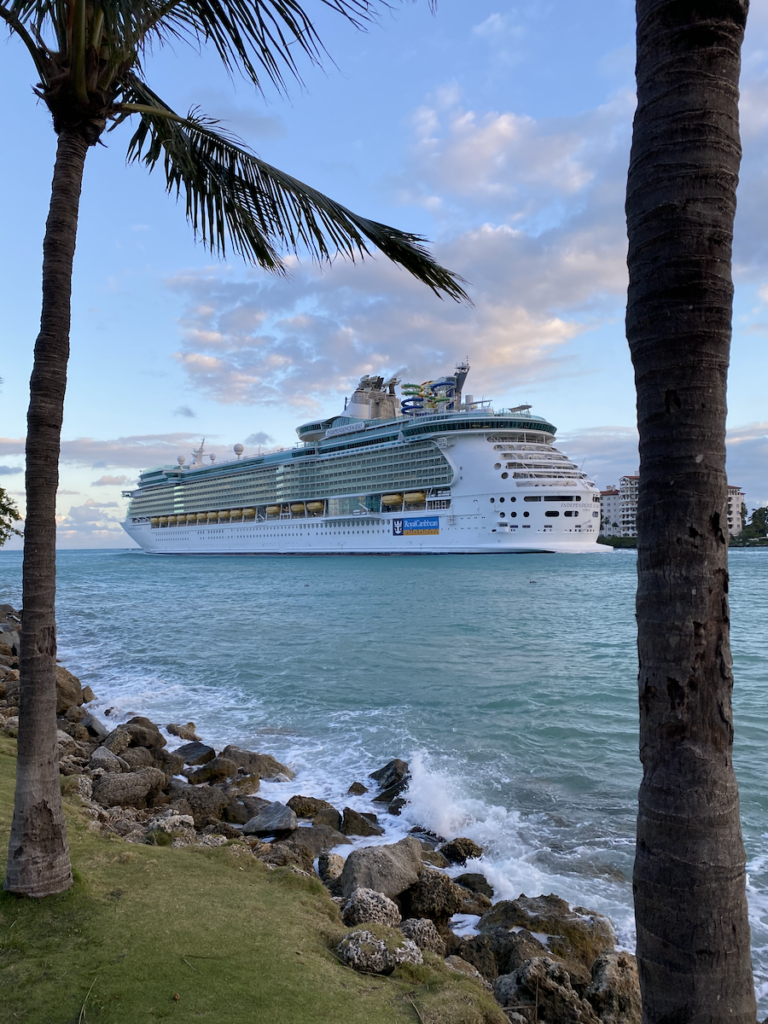
If you remember anything from this article, remember Flag of Convenience, or FOC. FOC is when cruise lines register their ships under the flags of countries different from where the company is headquartered. Why? To take advantage of that country’s laws. The ones that favor the cruise industry and its stockholders the most are those around labor. According to the Cornell Undergraduate Law and Society Review, approximately 40% of the world’s fleet is registered to either Panama, Liberia, or the Marshall Islands as of 2022.
It didn’t start that way though. During Prohibition, US ships registered in Panama so they were able to legally serve alcohol. Once Prohibition ended, they maintained their Panama registrations in order to continue enjoying the other advantages. Unlike US or European labor laws, these registries let cruise companies hire whoever will work for the lowest wage, with no nationality quotas, no strict working hour limits, and minimal training requirements. According to the Legal Clarity Team, the International Convention on Standards of Training, Certification and Watchkeeping for Seafarers sets the standard, but the flag state has the final say.
Crew
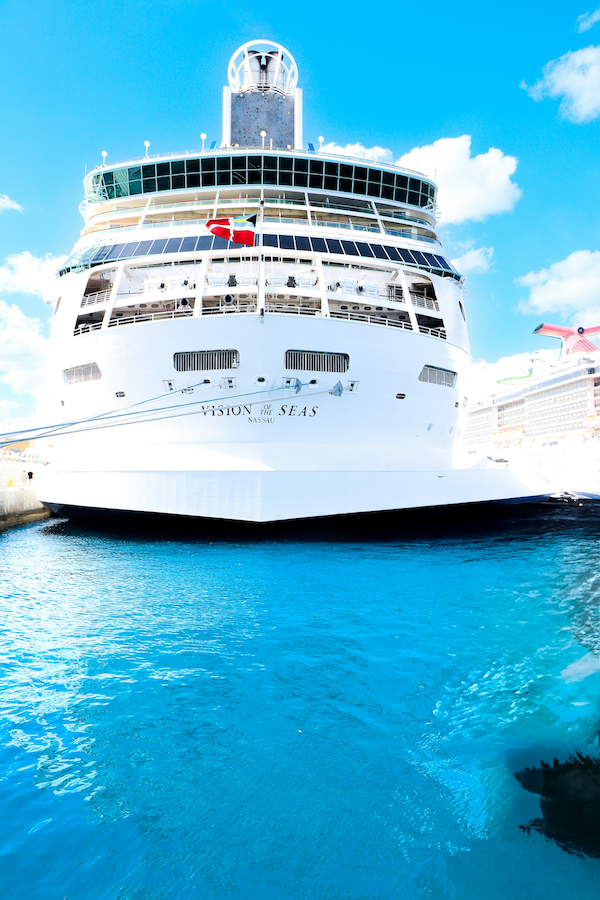
Crew members receive a place to stay but are often away from their families for long stretches at a time, with contracts ranging from a few months to a year. Andrew Yarrow, a teacher at George Mason University and a former New York Times reporter, wrote in the Milken Institute Review about a Filipino woman who shared that she makes less than $1,500 per month, shares a cabin with several roommates, and has never had a full day off. This story is sadly not an exception. DW, a German international broadcaster, reports that although working hours have been regulated internationally since 2006 by the Maritime Labor Convention, they are consistently violated.
Angela Teberga, a professor of tourism at the University of Palmas in Brazil, concluded in her doctoral thesis that working up to 14 hours a day, seven days a week, is the rule rather than the exception. According to Roundtable Human Rights in Tourism, the Maritime Labour Convention defines minimum standards including a working time limit of 14 hours per day and 72 hours per week, as well as requirements around the size and comfort of staff accommodation. They note that while these standards exist, the FOC system makes it extremely challenging for employees to be heard when a violation occurs.
My Own Research
I spent time chatting with a bartender in New York City who had spent a few years working on a cruise ship. His feelings toward the industry were clearly mixed. The work allowed him to see the world and leave his home in Serbia, but the conditions were demanding. Contracts ran nine months long, with a base wage of around $1,500 USD per month before tips. For him, gratuities roughly doubled that figure to about $3,000 USD monthly, a perk he acknowledged wasn’t shared by most of his colleagues. The majority of roles on the ship received no tips at all and earned considerably less.
The living situation was not ideal. He shared a small room with four others and clocked around 85 hours a week. When the conversation turned to food, he noted that the guest experience was excellent, but crew members ate an entirely different menu. He didn’t go into detail, though the smirk on his face said enough. I left our conversation with the understanding that he felt it was almost a bootcamp type learning experience (my words, not his) and he was glad he did it, but it was by no means a way to earn a living and spend a life. It also confirmed my research, with the financial figures and living conditions matching almost exactly what I had understood for years.
Environmental Impacts
Unlike the labor concerns surrounding the industry, the environmental impact cruise ships have on our oceans is far more publicized. Back in 2019, Carnival Cruise Lines and its Princess subsidiary were forced to pay $20 million in penalties for environmental crimes, coming after Princess had already been required to pay $40 million for deliberate acts of pollution. The impacts span water pollution, air pollution, noise pollution, and solid waste.
According to Earth.Org, a 3,000-person ship generates 176,400 gallons of sewage per week, adding up to over one billion gallons a year for the entire industry. On the air pollution front, the numbers are equally hard to ignore. In Europe alone, a fleet of just over 200 cruise ships produced more sulfur oxide emissions in 2022 than a billion cars, dwarfing the output of every passenger vehicle on the continent combined.
Carbon
The International Council on Clean Transportation studied the carbon footprint of a weeklong cruise compared to a weeklong road trip, and the results are striking. Even two people driving a gasoline-powered SUV for the entire week would produce less than half the greenhouse gas emissions of a comparable cruise vacation. The study even extended the scenario to a 2,300-mile drive with two weeks of hotel stays, and the road trip still came out cleaner than the cruise.
Economic Concerns
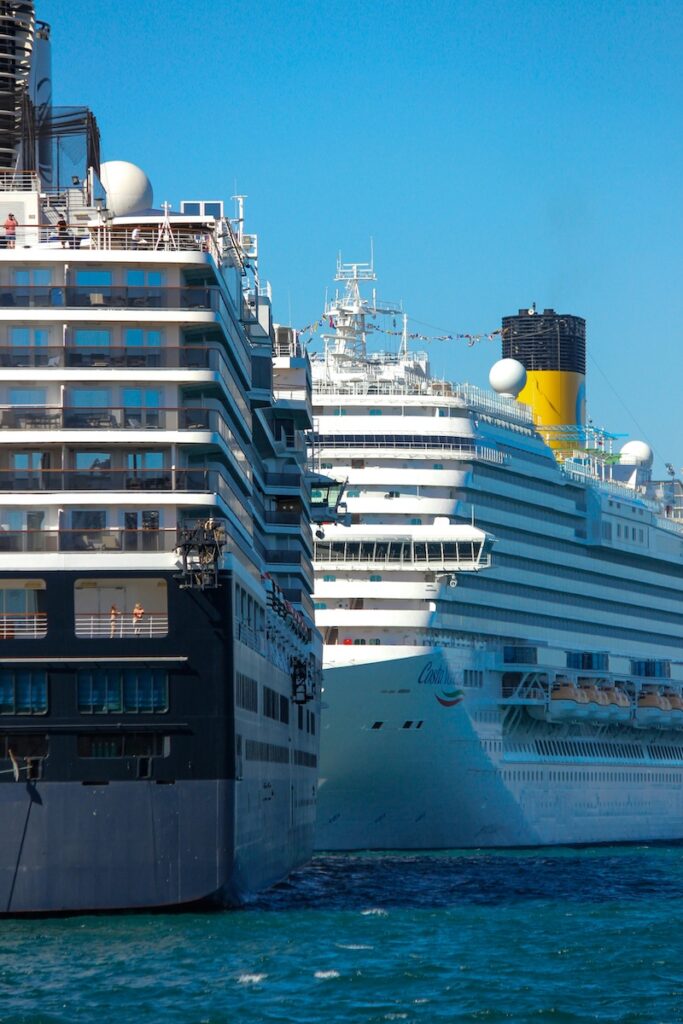
According to annual report filings analyzed by The Hustle, the major cruise lines pay an average tax rate of just 0.8%, compared to the 21% US corporate rate. They market themselves as American companies, but they are registered as foreign entities, hiding behind the same FOC system described above.
In a recent video, travel vlogger Simon Wilson offered a glimpse into the economic reality that port cities face when cruise ships arrive. Most people assume that thousands of disembarking passengers pour money into the local economy. Monica, a taxi driver who works the Nassau port daily, told Wilson otherwise. Cruise passengers, she explained, rarely spend money in town because they have already eaten on the ship. Most simply walk around and head back. It is a sentiment that aligns with research showing cruise lines take up to 70% of onshore revenue, leaving local vendors and communities with very little in return.
Pushback
The cruise industry does not accept this characterization without pushback. According to the Cruise Lines International Association, the industry generated $168.6 billion in total global economic impact in 2023, a 9% increase over pre-pandemic levels. The association also points to 1.6 million supported jobs and $56.9 billion in wages paid globally, with 77% of those jobs being land-based. CLIA further argues that the economic ripple effect extends beyond the voyage itself, citing its own research suggesting that 60% of cruise passengers return to destinations they first visited on a cruise for a longer independent stay. It is worth noting, however, that CLIA is the cruise industry’s own trade association, meaning these figures come directly from the industry rather than an independent source.
Wrap-Up
As you can see, the cruise industry has a dark side, one that simply cannot be ignored and is fortunately receiving growing attention. Yes, other industries, especially in international travel, have their own dark secrets. Airplanes are responsible for significant air pollution and hotels have been known to have labor violations. No industry, however, seems to be as blatantly reckless and careless with such little regard for people and the planet as the cruise industry.
I think back to the bartender I met in New York, glad he did it but clear-eyed about what it cost him and what it is costing others today. I think about Monica waiting outside the port gates every morning, watching thousands of people walk past without spending a dollar. Nothing I found in researching this piece suggests the benefits come close to justifying the cost. There are better ways to explore the world and truly experience the culture of the places these ships dock. Ways that put money in the hands of the people who actually live there, and leave the ocean and the world a little better than you found it.
Have thoughts on the cruise industry? Agree, disagree, or have a story of your own? I want to hear it. Leave a comment below.
Note: The featured image, depicting a cruise ship navigating stormy waters beneath a magnifying glass revealing the word ‘truth,’ was created with the assistance of AI.
We don’t own the planet Earth, we belong to it. And we must share it with our wildlife.
Steve Irwin
FAQ
Flag of Convenience, or FOC, is when a cruise line registers its ships under the flag of a foreign country to take advantage of that country’s more lenient laws. This allows cruise companies to bypass strict labor protections, pay minimal taxes, and avoid regulations they would otherwise face if registered in the United States or Europe.
It depends on the role. Bartenders and other tipped positions can earn around $3,000 USD per month including gratuities, but the majority of crew members receive no tips at all and earn considerably less. Some workers report earning under $1,500 per month while working up to 14 hours a day, seven days a week, for contracts lasting up to a year with no days off.
Despite generating billions in revenue and marketing themselves as American companies, the major cruise lines pay an average tax rate of just 0.8%, compared to the 21% US corporate rate, by registering as foreign entities under the FOC system.
The environmental impact is significant. A single 3,000-person ship generates over 176,000 gallons of sewage per week. In Europe alone, a fleet of just over 200 cruise ships produced more sulfur oxide emissions in 2022 than a billion cars combined. Studies also show that a weeklong cruise produces more than double the carbon footprint of a comparable road trip.
The picture is mixed. While the industry claims $168.6 billion in global economic impact and 1.6 million supported jobs, much of that money does not reach local communities. Research suggests cruise lines take up to 70% of onshore revenue, and many passengers simply walk around port cities and return to the ship without spending anything locally.
Some lines have invested in liquefied natural gas as a cleaner fuel alternative, though critics point out that methane, its primary component, is significantly more potent than carbon dioxide as a greenhouse gas. Environmental advocacy groups like Friends of the Earth argue that meaningful change requires a full shift to zero emission fuels, stronger sewage treatment standards, and an end to single use plastics onboard.




Is the Caribbean’s On-Island Resort Sector Being Crushed by the Cruise Industry?
In this week of the ALIS CALA annual Caribbean hotel investment conference, I found the latest report by the World Travel and Tourism Council, titled “Cruising For Impact”, to be highly pertinent – if rather biased. Given its significant reliance on data from the Cruise Lines International Association, the report read more like a P R exercise for the cruise industry.
There may be areas of the world where cruise lines still provide valuable benefits to local communities. However, over recent years, the opposite has become true in the Caribbean. The current business model of the cruise lines has become decidedly exploitive of the region with significant longer-term negative impacts on the region’s on-island tourism development, particularly, for existing hotels and new resort projects.
While my role over more than two decades involves Caribbean resort development, I have previous early experience of three years as a hotel officer on board cruise ships and, later, as Hotel Services V P for four explorer cruise ships. I believe that gives me a well-founded viewpoint in evaluating how passenger spend, operating costs and taxation applies to the cruise industry in the Caribbean, compared to the stay-over visitor tourism of island hotels, condo rentals, timeshare and marinas.
Today’s giant cruise ships have large scale leisure facilities on board including multiple restaurants, bars and shops, as well as casinos, spas and water parks, which all now present a direct disincentive to spending time – and money – in Caribbean ports. Ships now ban bringing duty free liquor on board in calling ports – on “security” grounds. Ships have their own jewelry and electronics shops on board. St Maarten is still one of the more successful cruise calling ports for retail outlets but, even there, the size of the duty-free retail sector in Philipsburg has shrunk considerably in recent years, thanks to direct competition from onboard shops.
Ships’ commissions for shore excursions have risen over the last few decades from 10% to 50%. That inevitably drives shore excursion prices significantly higher, as local companies struggle to operate vehicles and boats on a viable basis. The end result today is that a smaller percentage of passengers actually go on excursions and an increased ratio of passengers never go ashore at all in many Caribbean ports.
On that basis, any attempt to compare “spend per hour” from the reduced percentage of cruise ship passengers going ashore against the spend of longer-term stay-over tourists on the islands is fanciful. The average spend per cruise ship passenger, quoted in another recent “cruise friendly” article at $165 (over $30 per hour ashore), seems very dubious.
Average cruise ship ticket prices have declined in real terms over recent decades, attracting more budget-oriented passengers. After having to haggle with cruise ship passengers over the fare, most taxi drivers in the Caribbean will tell you – from their personal observation – that the average purchase per person ashore is more like “two beers and a tee shirt”. How does that start to even compare with the average stay-over guest’s vast spend on island accommodation, restaurants, bars, car rental and day trips?
A March 2025 World Bank report, argues that the region’s reliance on high-volume cruise tourism is unsustainable, yielding the world’s lowest revenue per cruise visitor at $37–$139 per visit compared to over $1,600 for stay-over visitors.
That brings us to the question of comparables in operating costs and taxation. Cruise ships inevitably benefit from much lower operating costs, due to their tax structures in off-shore jurisdictions and from their ultra-low direct wage costs for most of their third world sourced crew. However, island-based companies in the hospitality sector pay high local taxes and employ local staff – at the very least – on a legal minimum wage basis. Those local payrolls, including income tax and national insurance contributions, have a beneficial multiplier effect across island economies on a much higher ratio than direct cruise ship revenue.
In the Caribbean cruise ships currently pay very low port taxes on a per passenger basis, contrary to the much higher taxes levied in Alaska, New England, Canada and the Mediterranean. It appears that the Caribbean genuinely needs to catch up or remain being unfairly exploited in this respect.
In the meantime, the stay-over visitor contributes to local taxation via very high taxes for airport arrivals / departures and on local air tickets themselves. Taxes in the Caribbean can constitute up to 50% of ticket prices, compared to a global average of 15%. These high airline related taxes have negatively impacted the Caribbean’s intraregional air travel and local airlines operate with only marginal viability.
Hotel occupancy taxes and sales / value added taxes represent further stay-over visitor contributions, as well as customs import duty on the multiple items which those visitors consume on island.
The imbalance in operating costs, taxation and profitability seems clear between the cruise industry and the Caribbean based hospitality sector. However, there is an even greater and longer-term insidious impact on the region. The Caribbean currently has the highest density of cruise ship operations in the world, particularly, in the Caribbean’s winter high season.
It is my contention that this high-volume presence acts in many ways as damaging unfair competition to the region’s onshore accommodation providers. This is particularly impactful when winter high season occupancy and room rates are critical for the financial success of Caribbean resorts – but most cruise ships reposition to other high season destinations elsewhere in the summer. Furthermore, this level of competition from the cruise sector represents a significant economic challenge to the viable development of new resorts in many islands, which already struggle with high construction costs, high energy costs and high shipping costs.
I really encourage governments in the region, as well as the WTTC, the Caricom Secretariat, the Caribbean Tourism Organization and the Caribbean Hotel & Tourism Association, to re-evaluate this imbalance and adjust their policies going forward.
Robert MacLellan
Managing Director,
MacLellan & Associates
http://www.maclellancaribbean.com
Robert, thank you for this thoughtful and detailed perspective. The seasonal imbalance you raised, with cruise ships dominating in winter then leaving for the summer, is a piece of the puzzle I had not fully considered, and it reframes the competition in a way that goes beyond what most travelers see.
The shore excursion commission jump from 10% to 50% is also striking. That alone explains so much about why prices have climbed and participation has dropped.
I appreciate you engaging with the piece, and I will likely revisit this topic in a future post.